Fit comes before style, always
A badly fitting saddle produces a horse that bucks on mounting, pins its ears when girthed, refuses to move forwards freely, and eventually develops white hairs and swellings along the back. None of this is behavioural stubbornness. It is pressure on tissue that was never designed to carry a rider.
Fit the saddle to the horse first and to the rider second. The rider can be accommodated by seat size and flap length; the horse cannot accommodate a tree that is the wrong shape.
The three measurements that matter
Gullet width. With the saddle off the horse and held at chest height, look through from the front: you should see daylight along the whole channel, roughly three fingers wide over the withers and the spine. Anything less and the pommel is bearing on bone.
- Tree angle. Arabian and Iberian types carry a broad, short, flat back with low withers; they need a wide, flat tree. Thoroughbreds and warmbloods need something narrower and more angled.
- Panel contact. Press evenly along both panels — the whole length should touch, with no bridging at the front or the back.
- Length. The saddle must not extend past the last rib into the lumbar region, which has no rib cage to support load.
Types and what they are for
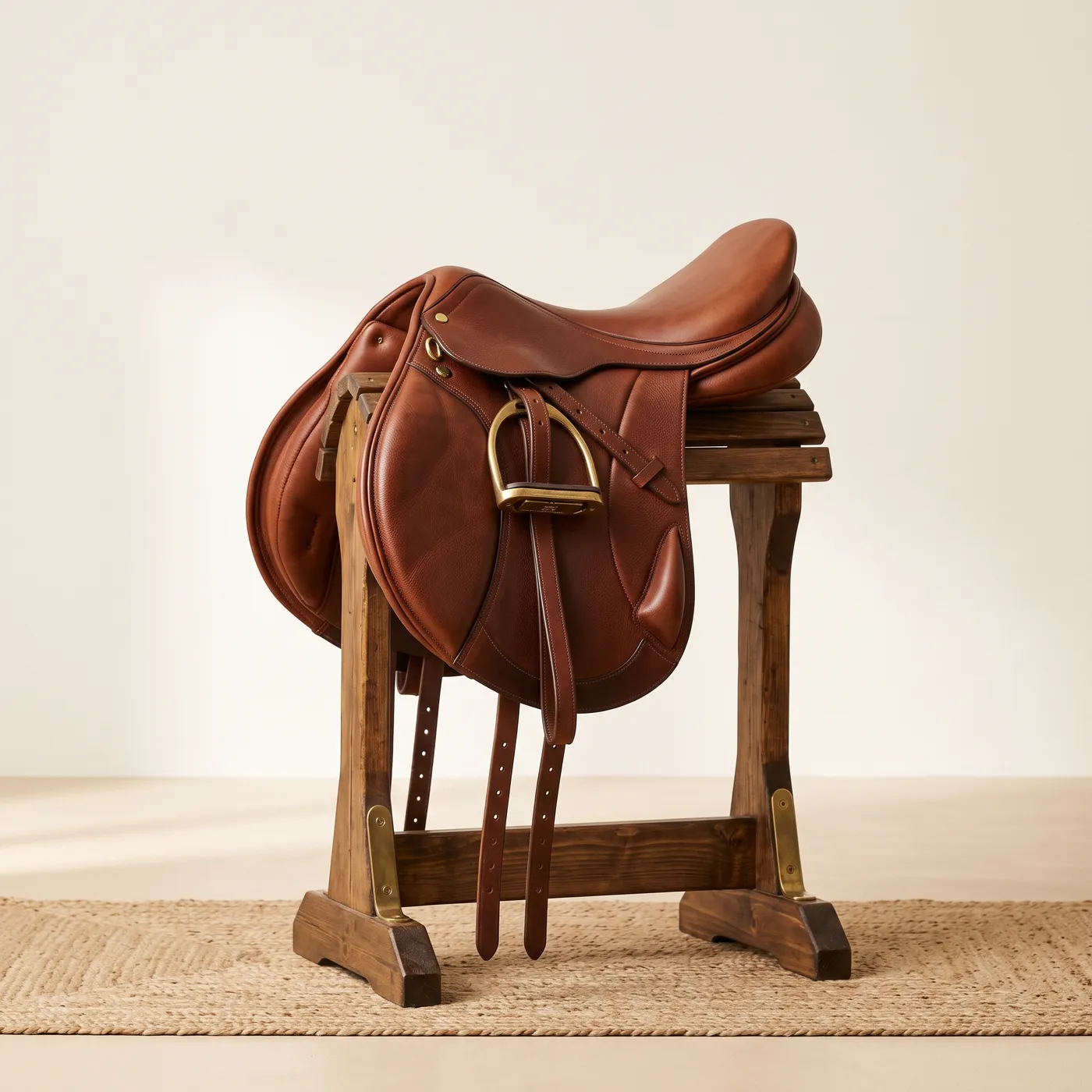
General-purpose saddles put the rider slightly forward and suit hacking and low-level jumping. Dressage saddles have a deep seat, a straight-cut long flap and long points — they position the leg under the hip and are the right choice for flatwork. Jumping saddles have a forward-cut flap and shorter points so the knee can close over a fence. Endurance and Arabian show saddles are lighter, often synthetic, with wider channels for the flat-backed horse.
Leather or synthetic in Gulf heat
Good vegetable-tanned leather, conditioned monthly, will outlast synthetic and mould to the horse. But the Gulf summer is brutal on it: 45 °C plus 80% humidity encourages mould in any tack room that is not ventilated or dehumidified. Synthetic saddles — often sold as "maintenance-free" — weigh less, wash down with a hose, and do not mould. For a yard running horses through July and August, a synthetic working saddle with a leather show saddle in the air-conditioned tack room is a perfectly sensible split.
Reading the sweat mark
After a workout, run your hand under the pad and look at the pattern on the horse's back. An even, symmetrical damp patch means even contact. Dry patches, ruffled hair, or a clear dry strip along the spine mean pressure points — the saddle is bridging and all the weight is going onto two small areas at the front and rear. Photograph both sides after every ride for a week and compare; asymmetry that repeats is a fitting problem, not a riding problem.
This summary is provided for convenience. The full registered text governs.